
A Better Model For True Intimacy
Mar 22, 2026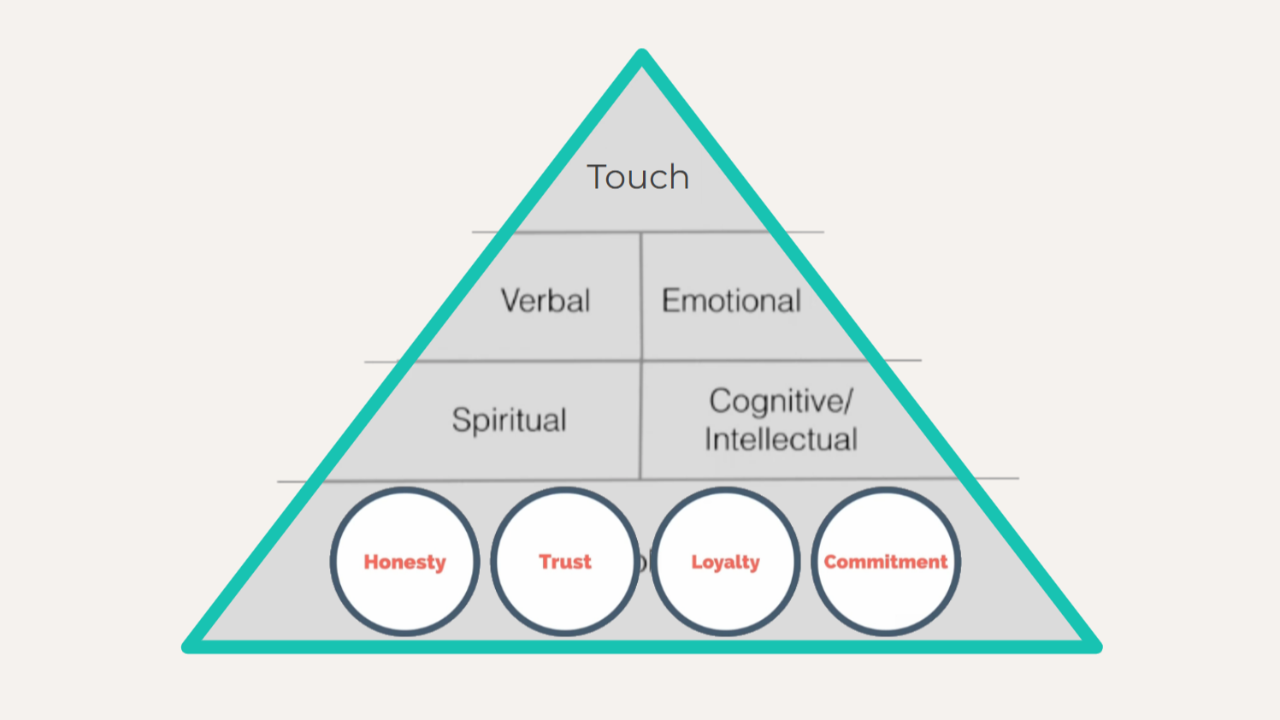
Most couples think they know what intimacy is. Betrayal doesn't just shatter that belief — it raises a harder question: was it ever accurate?
Because here's what almost no one says out loud in recovery: the goal isn't to get your marriage back. The marriage you had is what produced D-Day.
The goal is to build something that was never there. That requires a different map than most couples are working from.
A Better Map
Marriage and family therapist Kevin Skinner developed a framework that reorders how most couples think about intimacy. It arranges genuine connection as a triangle built from the ground up — and what's immediately striking is how little of that triangle has anything to do with sex.
Most couples work the triangle upside down. They reach for the top (sex) and wonder why nothing beneath it feels stable. This model shows why — and what to build instead.
Layer 1 — Psychological Safety
The entire triangle rests on four elements: Honesty, Trust, Loyalty, and Commitment. Without them, nothing above is secure. You can share a bed with someone for decades and never actually feel safe with them.
Safety takes continual work and any fracture in any one of these foundational elements must be repaired before reengaging anything above. That's why recovery starts at the bottom and works its way up.
Layer 2 — Relational Connection
Once psychological safety exists, four types of genuine connection become possible: Verbal, Emotional, Cognitive, and Spiritual.
- Verbal intimacy means honest, non-defensive communication about what's actually happening inside you.
- Emotional intimacy means naming your own inner world and bearing witness to your spouse's without losing your footing.
- Cognitive intimacy means genuinely knowing how your spouse thinks — their fears, their frameworks, their interior life.
- Spiritual intimacy means pursuing something larger than yourselves together, not just occupying the same pew.
Most couples I work with eventually realize they've been living almost entirely on the surface here. The skills built here don't just support Layer 3 — they transform what’s possible in Layer 3.
Layer 3 — Physical Connection
Physical connection sits at the top — and it has a sequence.
Non-sexual touch comes first. A hand held, a long embrace, a hand on the shoulder — touch that carries no sexual agenda. This isn't a warm-up. It's a distinct form of connection that requires the safety of Layer 1 and the attunement of Layer 2 to be experienced correctly.
A structured celibacy period is often where this gets built. With sexual touch off the table entirely, the pressure lifts, the triggers quiet, and couples discover non-sexual closeness as its own form of intimacy — often for the first time.
Many describe it this way: we finally experienced true intimacy, without sex — and it was nothing like anything we'd known before. That's exactly the point.
Sexual intimacy follows. It is the capstone — the smallest section of the triangle, rightly so. When sex becomes a natural outflow of psychological safety, relational connection, and non-sexual intimacy, sexual touch transforms into something most couples have never experienced. No longer a tool or coping mechanism, it becomes the pinnacle of holistic intimacy fully expressed through all forms of intimacy below it.
Couples who use this framework for intimacy consistently describe their experience during sex as incomparably better than any sex they experienced before D-Day. Why? Because they finally put sex in its rightful position… a result of intimacy, not a false substitute for it.
What Gets in the Way
The problem, for most couples, is sequence. Sex gets labeled as intimacy, placed at the center of the relationship, and used as a substitute for everything beneath it. The result is a triangle built upside down — all capstone, no foundation — held together by nothing.
The integrated approach corrects this by working the layers in order, deliberately, with both spouses in view simultaneously. A celibacy period removes access to the top of the triangle so the lower layers can finally be built. One guide holds all three layers in view throughout — individual work and relational work happening in parallel, neither spouse optimizing for their own comfort at the expense of the other or the system.
The triangle gets built from the bottom up, on purpose, with clear milestones along the way.
That's not a therapy technique. It's a different way of understanding what a marriage is for.
If you're not sure where you are in this journey — or whether your current approach is building from the ground up or just managing the top — The Roadmap is the place to start. It's a $25 orientation course that maps the entire integrated recovery process from Phase 0 to Phase 3, so you can see exactly where you are and what comes next.
START THE ROADMAP
RELATED:

Stay connected with news and updates!
Receive emails about new posts, free webinars, trainings and live events.
We hate SPAM. We will never sell your information, for any reason.
